
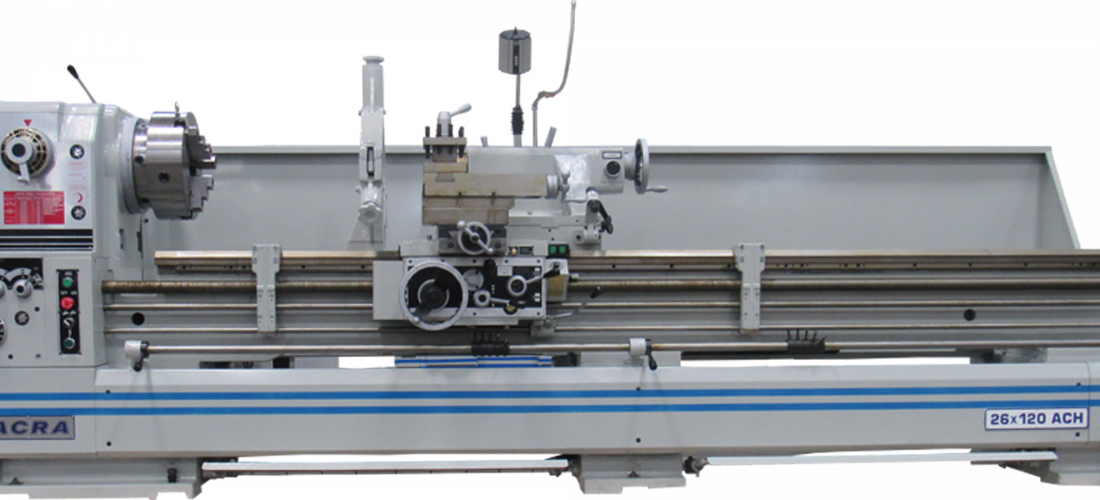
What Is a Lathe?
A lathe is a machine tool that spins a block of wood, metal, or other material on an axis. While the piece spins fast, a sharp tool presses against it to cut, shape, sand, or drill the material into a symmetrical object.
How Does a Lathe Work?
A lathe machine works by rotating a workpiece along a central axis while a stationary cutting tool presses against it. As the material spins, the operator or a computer moves the tool along the side or face of the part, shaving off extra material to create symmetrical, round, or cone-shaped final objects.
Common Types of Lathes
Engine Lathe (Center Lathe): The most common manual metalworking lathe. Used for general-purpose turning, facing, threading, and making custom parts.
CNC Lathe: Controlled by computer software for automated, high-precision manufacturing. Used for complex, multi-axis geometry in aerospace and medical device production.
Turret Lathe: Features a multi-tooled rotating turret instead of a tailstock. Used for fast, repetitive mass production of identical parts.
Tool Room Lathe: A highly accurate version of an engine lathe optimized for fine work. Used to make precision tools, dies, and gauges.
Bench Lathe: A small, lightweight lathe mounted on a workbench. Used for delicate, high-tolerance small parts and hobbyist or jewelry work.Wood Lathe: Built specifically to spin wood stock rather than metal. Used by artisans to craft bowls, spindles, table legs, and baseball bats.
Swiss-Type Lathe: A specialized production lathe where stock slides through a guide bushing. Used for long, slender, and intricate micro-components like watch parts or medical pins.
Components of a Lathe Machine
Base and Frame
Bed: The heavy, rigid cast-iron base that supports all other main components and maintains alignment.
Ways (Guideways): Precision-machined tracks on top of the bed that guide the carriage and tailstock smoothly.
Headstock and Power
Headstock: Housing on the left side that contains the motor, gears, and pulleys.
Spindle: The main rotating hollow steel shaft driven by the motor.
Chuck: The clamp attached to the spindle that holds the workpiece.
Carriage and Tool Control
Carriage: The assembly that slides along the bed to guide the cutting tool.
Saddle: An H-shaped casting riding directly on the bedways.
Cross Slide: Sits on top of the saddle to move the tool inward and outward for depth control.
Compound Rest: Mounted on the cross slide; pivots to allow angled cuts and tapers.
Tool Post: Clamps the cutting tool or tool holder securely in place.
Apron: Hangs from the saddle, housing the gears and levers that feed the carriage.
Tailstock and Support
Tailstock: Movable unit on the right side used to support the free end of a long workpiece or hold drill bits.
Tailstock Quill (Spindle): The sliding barrel inside the tailstock that holds a center or drill taper.
Feed and Threading
Lead Screw: A long threaded rod that drives the carriage automatically during screw-cutting.
Feed Rod: A smooth rotating shaft used for standard power feeds.
Common Lathe Operations
Turning: Cutting along the outside length of a part to reduce its overall diameter.
Facing: Feeding the tool across the flat end of the part to make a clean, flat surface.
Boring: Enlarging or smoothing an existing hole inside the workpiece.
Threading: Cutting a spiral groove or screw thread onto a cylinder.
Drilling: Holds a drill bit to make a hole in the center of the spinning part.
Knurling: Rolls a rough pattern on a metal surface for a better hand grip.
Who Uses A Lathe?
Woodturners: Crafters who make bowls, table legs, vases, and pens.
Metal Machinists: Fabricators who build custom metal shafts, pins, pulleys, and threads.
Hobbyists & Model Makers: DIYers creating custom plastic, brass, or wooden components for miniature models or restorations.
Prototyping & Manufacturing Labs: Production engineers creating precise, symmetrical components on manual or CNC machines.
What Can A Lathe Make?
Industrial and Automotive Parts: Driveshafts, axles, bushings, pins, and custom washers.
Fasteners and Hardware: Screws, bolts, nuts, and threaded pipes.
Woodwork and Furniture: Bowls, rolling pins, chair spindles, and table or desk legs.
Decorative and Specialty Items: Chess pieces, candlesticks, gun barrels, and wooden or plastic handles.
Cylinders and Cones: Shaving down raw stock into smooth, perfectly round rods.
Facing and Boring: Flattening the ends of a part or hollowing out the inside of a cylinder.
Threading: Cutting precise internal or external screw threads.